Dr. Gomoll's work covered by CBS, ABC, ESPN, Becker's, the Joe Rogan Experience, and major orthopedic podcasts — featuring cartilage repair, coral implants, MISHA, Hyalex, and stem-cell trials.
Dr. Gomoll's research and clinical work has been featured by CBS, ABC News, ESPN, Becker's Hospital Review, and the Joe Rogan Experience (David Goggins discussing his HTO at HSS). Coverage spans the Cartiheal coral implant, the MISHA partial knee implant, Hyalex cartilage system, FDA trials of meniscal spacers, and umbilical-cord stem-cell transplantation for cartilage repair.
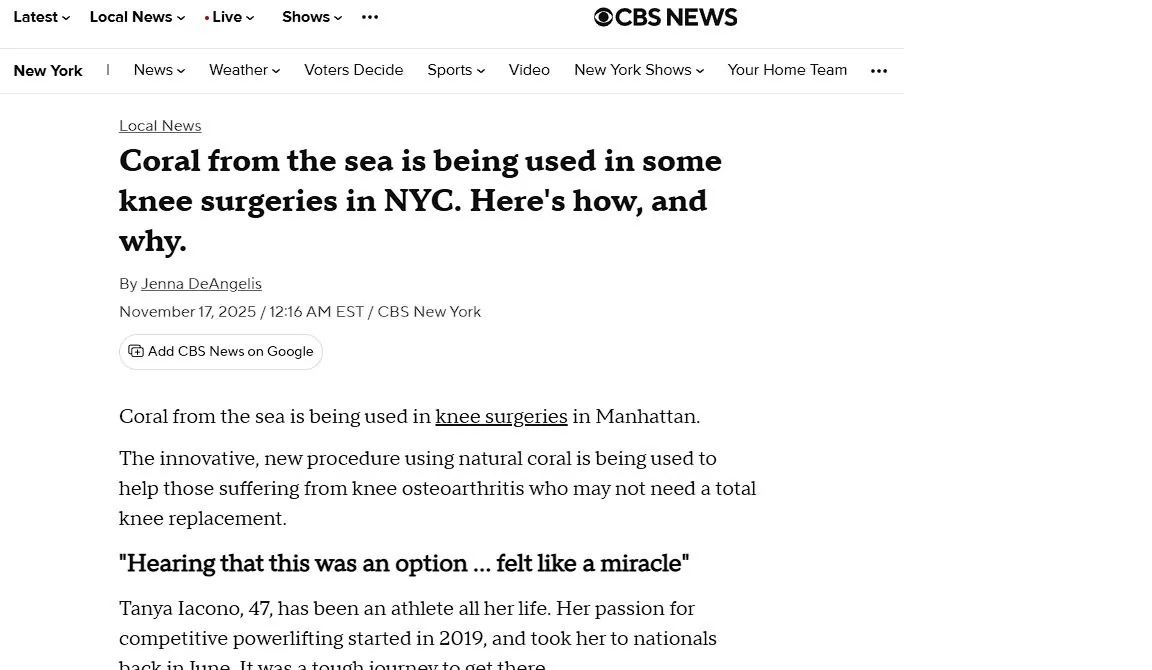
CBS featured Dr. Gomoll in a story about the Cartiheal coral implant — a new treatment option for cartilage defects in the knee that he has been using for nearly 3 years. He was an investigator on the FDA approval trial.
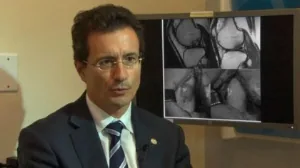
Dr. Mallika Marshall from CBS reports on Dr. Gomoll's stem-cell trial for cartilage defects.
Watch
Video features
Dr. Gomoll on the David Goggins / Joe Rogan Experience
David Goggins on the Joe Rogan Experience discussing his high tibial osteotomy performed by Dr. Gomoll at HSS.
FDA unloading device trial. Dr. Gomoll treats the first patient in the US with the new MISHA unloading device for knee osteoarthritis
Dr. Gomoll treats the first patient in the US with the new MISHA unloading device for knee osteoarthritis, as part of the FDA trial.
Transcript
CENTER 5'S EMILY REIMER SHOWS US HOW IT WORKS. >> IT FELT LIKE A DULL ACHE ALL THE TIME. EMILY: DAVID DESNOYERS HAD NO PATIENCE FOR HIS KNEE PROBLEM. >> I RUN. I PLAY ICE HOCKEY. EMILY: BUT FOR THIS 53-YEAR-OLD GRANDFATHER, THE PAIN ONLY GOT WORSE. >> MY KNEE WAS GETTING TO THE POINT WHERE I COULDN'T DO THOSE THINGS AS MUCH OR AS WELL AS I LIKE TO. EMILY: THESE X-RAYS SHOW WHY. NORMAL KNEES HAVE A CUSHION OF CARTILAGE SEPARATING THE BONES. >> AND WHAT'S NOT NORMAL IS WHAT WE SEE ON THE LEFT KNEE, WHERE YOU CAN SEE HOW THE BONES TOUCH. EMILY: DAVID'S DIAGNOSIS -- OSTEOARTHRITIS FROM ACTIVE WEAR AND TEAR IN HIS JOINT. >> IN THE LATE STAGES, IT HURTS ALL THE TIME. EMILY: FOR YEARS, DAVID WORE THIS BULKY BRACE WHEN HE PLAYED SPORTS. >> IT HELPED, BUT IT WAS NOT A LONG-TERM SOLUTION. EMILY: AND FOR DAVID, NEITHER WAS A FULL OR PARTIAL KNEE REPLACEMENT THAT CAN REQUIRE MANY MONTHS OF REHAB. >> TOO INVASIVE FOR ME. TOO YOUNG. TOO MUCH DOWNTIME. EMILY: DR. ANDREAS GOMOLL OFFERED A NEW OPTION -- SIGNING UP FOR A NATIONWIDE FDA TRIAL TO TEST THIS IMPLANT THAT'S SURGICALLY ATTACHED TO THE BONES WITH SCREWS. >> ESSENTIALLY, YOU ADD A SHOCK ABSORBER, WHERE EVERY TIME YOU TAKE A STEP, THAT LITTLE CYLINDER TAKES AWAY SOME OF THE STRESS. I THINK THAT'S A REALLY INTERESTING OPTION. EMILY: AND DAVID IS THE FIRST PATIENT IN THE UNITED STATES TO TEST IT OUT. HE HAD THE SURGERY AT BRIGHAM AND WOMEN'S IN NOVEMBER. >> I WAS WEIGHT-BEARING RIGHT AWAY. EMILY: AND WITHIN TWO WEEKS, HE WAS OUT ON THE ICE WITH HIS GRANDDAUGHTER. >> IT'S BEEN GREAT TO GET OUT THERE AND BE, YOU KNOW, BE ACTIVE AGAIN. EMILY: EVEN DR. GOMOLL IS IMPRESSED WITH THE QUICK PACE OF DAVID'S RECOVERY. >> I THINK HE'S A BIT OF A SUPERSTAR, BUT IT CERTAINLY SHOWS WHAT THE IMPLANT CAN WITHSTAND. AT THE END OF THE DAY, ANYTHING THAT HE FEELS HE CAN TOLERATE, IT'S OK WITH ME. EMILY: THIS TRIAL WILL TAKE A FEW YEARS TO COMPLETE. DOCTORS WANT TO KNOW HOW STABLE IS THIS IMPLANT, HOW QUICKLY DOES IT WEAR OUT? BUT IF SUCCESSFUL, IT COULD OFFER AN APPEALING NEW OPTION FOR YOUNGER, ACTIVE PATIENTS
Dr. Gomoll on ESPN's Weekend Warrior
Dr. Gomoll discusses stem cells with Dr. Klapper on the ESPN Weekend Warrior radio show.
Transcript
DURING SWIFT'S CONCERT IN SYDNEY THE PAIR MET AND SHE GAVE HER TICKETS. PRIME SEATING AT THE SHOW. Heather: THAT'S A LOVELY STORY. A BROCKTON MAN IS THE FIRST TO UNDERGO A GROUND BREAKING KNEE SURGERY. THERE ARE FEW TREATMENT OPTIONS FOR THE THOUSANDS OF YOUNGER PEOPLE WHO SUFFER A TORN MENISCUS. EMILY SHOWS US THERE ARE WOMEN WHO CAN HELP CHANGE THAT. Reporter: BASKETBALL HAS BEEN A CENTRAL PART OF ROB PRICE'S LIFE. I PLAYED MY WHOLE LIFE. I WOULD PLAY PICK UP IN THE DRIVEWAY AND PLAY WITH MY UNCLES. Reporter: HE PLAYED THROUGH SCHOOL AND NEVER STOPPED UNTIL ABOUT 10 YEARS AGO. ONE DAY AT PRACTICE, NO WARNING, NO NOTHING. Reporter: DOCTORS HAD TO REPLACE HIS ACL. ROB ALSO TORE HIS MENISCUS AND IT HAD TO BE REMOVED. IT DIDN'T STOP THE PAIN. WITHOUT THE MENISCUS IT WAS BONE ON BONE. Reporter: HE IS BEING TREATED BY AN ORTHOPEDIC SURGEON. EVERY TIME THEY STEP IT IS A HARD NOT CUSHIONED BLOW. Reporter: HE DESCRIBES THE MENISCUS AS A SHOCK ABSORBER. EACH KNEE HAS TWO. YOU CAN SEE A BLACK RYE ANGLE RIGHT THERE. Reporter: THIS IS ROB'S. YOU WOULD WANT TO SEE A BLACK TRIANGLE HERE. Reporter: THE MENISCUS WEARS DOWN AS WE AGE. IN THE YOUNGER PEOPLE THEY ARE OFTEN INJURED, BUT THE KNEE REPLACEMENT SURGERY IS NOT TYPICALLY AN OPTION. IT IS SOMETHING WE PREVIOUSLY HAD NO TREATMENT FOR. Reporter: BUT THAT MAY BE CHANGING WITH THIS. THE NEW SURFACE MENISCUS IMPLANT IS UNDERGOING THE TRIAL AND HE IS THE FIRST DOCTOR TO TRY IT. YOU DON'T HAVE TO CUT BONE AND YOU DON'T HAVE TO PERMANENTLY ALTER THE ANATOMY OF THE KNEE JOIN. Reporter: THE I'M PLANT SIMPLY POPS IN BETWEEN THE TWO BONES IN THE KNEE. NO SUTURES, NO SCREWS, A FAST RECOVERY ABOUT TWO OR THREE MONTHS. YOU DON'T NEED CRUTCHES VERY LONG, JUST A FEW WEEKS. I WOULD LIKE TO RUN, PLAY BASKETBALL. Reporter: HE IS THE FIRST PATIENT HERE TO GET THE IMPLANT. HE CAN'T WAIT TO BE PAIN FREE AND HE KNOWS HIS EXPERIENCE WILL ALSO HELP OTHER PATIENTS. ROB HAD THE SURGERY A WEEK AGO AND SAYS HE IS DOING WELL. THE IMPLANT IS ALREADY IN USE
Channel 5 — FDA meniscal spacer trial
Channel 5 report on Dr. Gomoll's FDA trial of a new meniscal spacer device — for symptomatic patients who lost their medial meniscus to injury but before arthritis develops.
Transcript
FAULTY PROPANE TANK SUSPECTED AS POSSIBLY STARTING THE FIRE, STILL UNDER INVESTIGATION. A FASTER RECOVERY FROM KNEE SURGERY AND STRONGER TISSUE THAT WILL LAST LONGER. THAT IS THE PROMISE TONIGHT OF A NEW PROCEDURE. ONE OF ONLY TWO HOSPITALS IN THE COUNTRY GIVING IT A TRY. AND MAN IS ALREADY SEEING RESULTS. IT'S MORE OF A MENTAL GAME. A MENTAL GAME AND PHYSICAL STRUGGLE FOR SEAN FAIR. I HAVEN'T BEEN IN THE GYM IN 15 MONTHS, LONGEST. THE 34-YEAR-OLD A NEW DAD HAS BEEN ACTIVE ALL HIS LIFE. FOOTBALL, BASKETBALL, BASEBALL, TENNIS, LACROSSE, GOLF. BUT SEVERE KNEE PAIN HAS SIDELINED HIM FOR MORE THAN A YEAR. DOCTOR AN ORTSDZ HOPEDIC SURGEON SHOWS A HEALTHY KNEE. HE HAS A POTHOLE. IT HE HAS ONE AREA THAT HAS A BIG POTHOLE. THE CART HREUPBL IS PEELING OFF. THE EASY FIX IS A KNEE REPLACEMENT. SOMEONE AS YOUNG AS SEAN THAT WOULDN'T BE AN OPTION. YOU DOUN'T WANT TO GET TO THAT STAGE. HE WENT ON THE WAITING LIST. AFTER MONTHS WITHOUT RESULTS HE OPTED FOR A CLINICAL TRIAL. SHAWN BECAME ONE OF THE FIRST U.S. PATIENTS TO HAVE A GROUND BREAKING TREATMENT A COMPANY IN KOREA IS USED STEM CELLS FROM THE UMBILICAL CORD. IT FILLS THE DEFECT AND THEY START PRODUCING. THE PROCESS CAN REDUCE RECOVERY TIME AND THAT NEW TISSUE WILL BE STRONGER THAN WHAT YOU GET IN TRADITIONAL PROCEDURES. ALMOST TWO MONTHS AFTER SURGERY, SHAWN IS REGAINING MOVEMENT. LESS PAIN, MUCH MORE MOBILITY. HE'S ALMOST READY TO SHED THE KNEE BRACE AND CRUTCHES. FULL RECOVERY COULD TAKE A YEAR
Channel 5 — FDA umbilical stem cell transplantation trial
Channel 5 report on Dr. Gomoll's FDA umbilical stem-cell trial for cartilage repair.
Transcript
even a 12-time Olympic medal winner like 43 year old Dara Torres can suffer from a debilitating injury with great for arthritis and virtually no cartilage in her left knee this five-time Olympian sought out the cartilage repair center at BWH I had so much damage in my knee that it was really what were we gonna do where we getting it the best care and will I be able to have the same quality of life and be able to swim again it was really a decision between a knee replacement which essentially meant stopping sports stopping athletics or trying cartridge repair Dara was a candidate for a CI autologous chondrocyte implantation we use chondrocytes that we get in in a nice coat we take these chondrocytes or cartilage cells we grow more from them and these Congress has already know what they want to become and they want to make cartilage so there's no confusion there the whole process takes about six weeks and you grow from about one hundred fifty thousand two hundred thousand cells until you reach the order of 40 million cells and then in a second procedure the patient comes back and now unfortunately we need to actually open up the knee and that's the process that's about as involved as a total knee replacement because you need to really see the defect it's very fine work and in that process we implant the cells and in that space you inject the fluid with the cells and then over time the cells attach to the bone and produce more partition and eventually it fills the hole basically it's all me I'm not getting it from some foreign body or anything like that anything else like that it's it's my cartilage dr. Gamel compares this process to filling potholes on a street maybe local municipality should pay attention so this ACI a autologous chondrocyte implantation and where I take cartridge cells and put them back into the joint that's really something for large and multiple potholes in the name so that's one of the more advanced techniques that really only a few specialized centers in the u.s. apply I couldn't believe that they did stuff like this I didn't I didn't even know they did and I've even tweeted about it and people I have twitter and people are like wow we had no idea that that a doctor can do this dr. Gamel is quick to point out that every patient situation is different and a CI is not appropriate or necessary for everyone but for Dara Torres B WH provided a gold-medal solution as she vies for a spot on her sixth Olympic team she has already qualified for the next step the Olympic Trials there's no possible way I wouldn't be able to do this if I had not come to bring them a woman's and the cartilage para Center there's just there's no way that my knee would be where it is right now and where it needs to be to go for another Olympic Games
Cartilage repair with ACI
Dr. Gomoll discusses cartilage repair using autologous chondrocyte implantation (ACI).
Transcript
welcome to your health information about today's top health topics direct from Brigham and Women's Hospital experts we want to remind you that this information should not replace the advice or recommendations from your healthcare provider hi I'm andreas como I'm an orthopedic surgeon specializing in Carter's repair at bringing Women's Hospital cartridge is a very complex tissue that covers the ends of all bones inside joints and it provides an almost frictionless surface and that's how it can withstand us taking between one and two million steps a year if it does not contain any blood supply and because of that once it's injured it cannot heal itself and that's where we come in as cartridge repair surgeons there are two different ways to injure cartage one which usually occurs in younger patients and the teens and 20s is so called acute cartridge damage and that can happen when you tell you a CL you dislocate your patella you essentially chip the cartridge and create a defect the damage that we see in older patients that's usually because of recurring micro damage it is and not an acute one-time injuring it is something that happens over time when you talk about cartilage damage by large we women a defect in the the cartilage and you can think of a cartridge defect either like a cavity in a tooth or like a pothole industry you have a street that otherwise looks good but there's one area one pot hole and just like potholes cartridge defects tend to get big over time so we really want to fill them before they get too large when you when you think about the field of cartilage repair there are many different ways of treating cartridge defects and you really need to look at the size and the location of the defect so ACI which stands for toddlers chondrocyte implantation has also known as cartas l was originally developed in sweden by a surgeon named Lars peterson and at that time there was really no technology like this available in the United States so my partner tom- traveled to Sweden and learned the technique and brought it to the US and he started the first cartridge repair center in the u.s. right here at Brigham and Women's Hospital and since that time more than 10,000 of these cases have been performing the US alone it's within the field of car to repair the most advanced technique it's an example of tissue engineering and different than other techniques it gives you a very high quality repair tissue that's very close to normal cartilage AC I originally was designed for the knee and that's the most common application over ninety percent of these procedures are done in the name it does involve two procedures and the first procedure is just an arthroscopic procedure where you go into the knee through two very small almost like poke holes and you look inside with the fiber optic camera you get a sense of the size and the location of the defect and if you feel that it's amenable to ACI then you take a small cartridge biopsy and it's just a piece of cartilage about the size of a tic tac and we can use that piece of cartilage to grow more carcass from it you performed tissue culture and multiply the cells until you have tens of millions of the cells this is a process that takes between four to six weeks you come back to re-implant the cells and that's a more involved procedure so here you need a true incision because you need to see the defects and actually clean out the defect to make sure that you have good surrounding healthy cartilage and then you take a piece of tissue and it's a membrane and you suture that over the defect so it's like a lid so that you have a small water type chamber because the cells come back as a liquid and you inject the the cells with a small syringe into this watertight chamber it it produces good cartilage but it also takes a very long time so usually when we do a CI our patients on crutches for anywhere between six and ten weeks they can do activities of daily living but we don't want them to run we don't want them to do any pivoting sports that has to wait until 12 to 18 months once the cartridge is really healed and has become much stronger so after everything is healed after 12 to 18 months I routinely let my patients go back to any activity they desire they can ski they can play tennis they can play basketball and find their own limitations and some patients are able to run marathons with no pain but that is a very lofty goal our goal from a physician side is I want to delay the need for joint replacement for you as long as possible and we found that in more than ninety percent of patients we could indeed delay via the need for joint replacement surgery for at least five to ten years thanks for watching your help from Brigham and Women's Hospital your health is intended for educational purposes only it should not take the place of advice or recommendations from your health care provider if you have questions about what you heard please consult with your doctor you
Notable mentions
David Goggins on the Joe Rogan Experience discussing his experience with a high tibial osteotomy performed by Dr. Gomoll at HSS. davidgoggins.com